
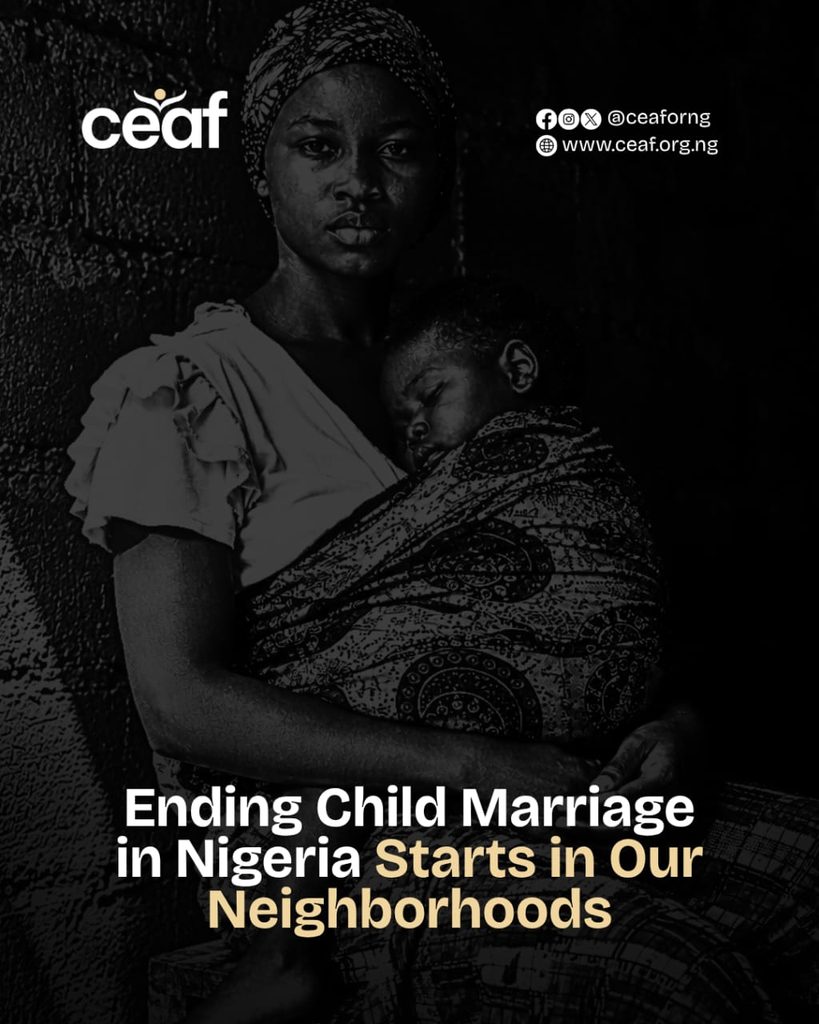
In many communities across Nigeria, a girl’s childhood ends far too early. Families facing severe economic hardship or deep-seated traditions often see early marriage as a safe path or a necessary financial survival tool.
According to UNICEF, Nigeria is home to over 24 million child brides. That is not just a statistic—it represents millions of young girls whose education, health, and dreams are cut short.
Laws alone cannot solve this problem. Legal frameworks exist on paper, but real, lasting change happens on the ground and real world—in town halls, places of worship, and family living rooms. Here is how local leaders, traditional authorities, and everyday neighbors can take actionable steps to protect girls and keep them in school.
In many rural and semi-urban communities, girl child are mistakenly seen as financial liabilities. When poverty deepens, marrying off a young girl is sometimes seen as one less mouth to feed or a quick way to secure a bride price.
Neighbors and local savings groups can help rewrite this story. When communities create small-scale financial networks—like local cooperatives, vocational training programs, or micro-grants for mothers—families do not have to resort to child marriage during financial crises.
Educating a girl is an economic asset, not a burden. A girl who completes secondary school earns more over her lifetime, invests back into her family, and raises healthier children.
Traditional rulers, village heads, and religious leaders hold immense sway in Nigerian communities. Their voices shape moral standards and social expectations far more than distant court rulings.
Change accelerates when leaders take concrete public stands:
- Refusing to perform marriage rites: Imams and pastors can mandate age verification before conducting any marriage ceremony.
- Preaching girl-child education: Faith leaders can use sermons to emphasize that protecting and educating young girls aligns with spiritual values.
- Creating community bylaws: Traditional councils can establish strict local penalties for families and older men who attempt to marry underage girls.
When a respected community head declares that child marriage hurts the entire village, public perception shifts rapidly.
In many neighborhoods, everyone knows when a young girl is suddenly withdrawn from school. Yet, out of fear of interfering in "family matters," neighbors often stay silent.
We need to treat child protection as a collective duty. Communities can set up local child protection committees—made up of trusted women, teachers, and youth leaders—to keep track of school attendance.
If a girl stops showing up to class:
- Teachers can alert the committee immediately.
- Committee members can visit the parents to understand the issue and offer support.
- Neighbors can speak up early before a formal marriage arrangement is finalized.
Intervening gently and early saves a girl's future without unnecessarily fracturing community ties.
School fees, uniforms, sanitary products, and unsafe transit routes are major barriers that push Nigerian girls out of school and into early marriages.
Everyday neighbors can make a tangible difference here:
- Pool resources: Local youth associations or church groups can sponsor school supplies or uniforms for families struggling financially.
- Organize safe walking groups: Parents can take turns escorting girls to and from school to protect them from harassment.
- Provide mentorship: Educated women in the community can mentor young girls, showing them what is possible when they stay in school.
Let us learn to:
- Speak up early: If you notice a young girl missing school continuously, report it to a trusted teacher or local child protection committee.
- Engage local influencers: Encourage your local religious and traditional leaders to speak publicly against underage marriage.
- Support girls' education directly: Help cover basic school supplies or mentor a young girl in your neighborhood.
- Challenge the culture of silence: Remind friends and family that child protection is a community responsibility, not just a private family matter.
0 Comments